
Insurance contracts: premiums collected today against claims paid far into the future.
The challenge
IFRS 17 is interdependent by design.
A change anywhere affects everything. Spreadsheets cannot keep up. Hamilton CEM was built for the complexity.
Long-dated uncertainty
Future cash flows, lapses, claims and expenses evolve over decades and many scenarios.
Interlocking assumptions
Discount rates, risk adjustment, CSM and onerous testing influence one another.
Two functions, one number
Actuarial owns the projections. Finance owns the reporting. When they sit in separate systems, every close becomes a reconciliation exercise.
The IFRS 17 chain
One controlled path from insurance contract to disclosure.
A consistent, auditable process that connects data, judgement and calculations to reliable outcomes.
- 1
Insurance contracts
All contracts within scope of IFRS 17.
- 2
Contract boundary & grouping
Define coverage groups by profitability alignment.
- 3
Expected cash flows
Project future cash flows and scenarios.
- 4
Discounting & risk adjustment
Apply current discount rates to cash flows.
- 5
Contractual service margin (CSM) allocation
Release stored profit to coverage units as service is provided.
- 6
Insurance result & finance result
Recognise results as coverage is provided.
- 7
Sub-ledger & general ledger
Post detailed contract-level movements.
- 8
Reporting & disclosures
Produce financial statements and IFRS 17 disclosures.
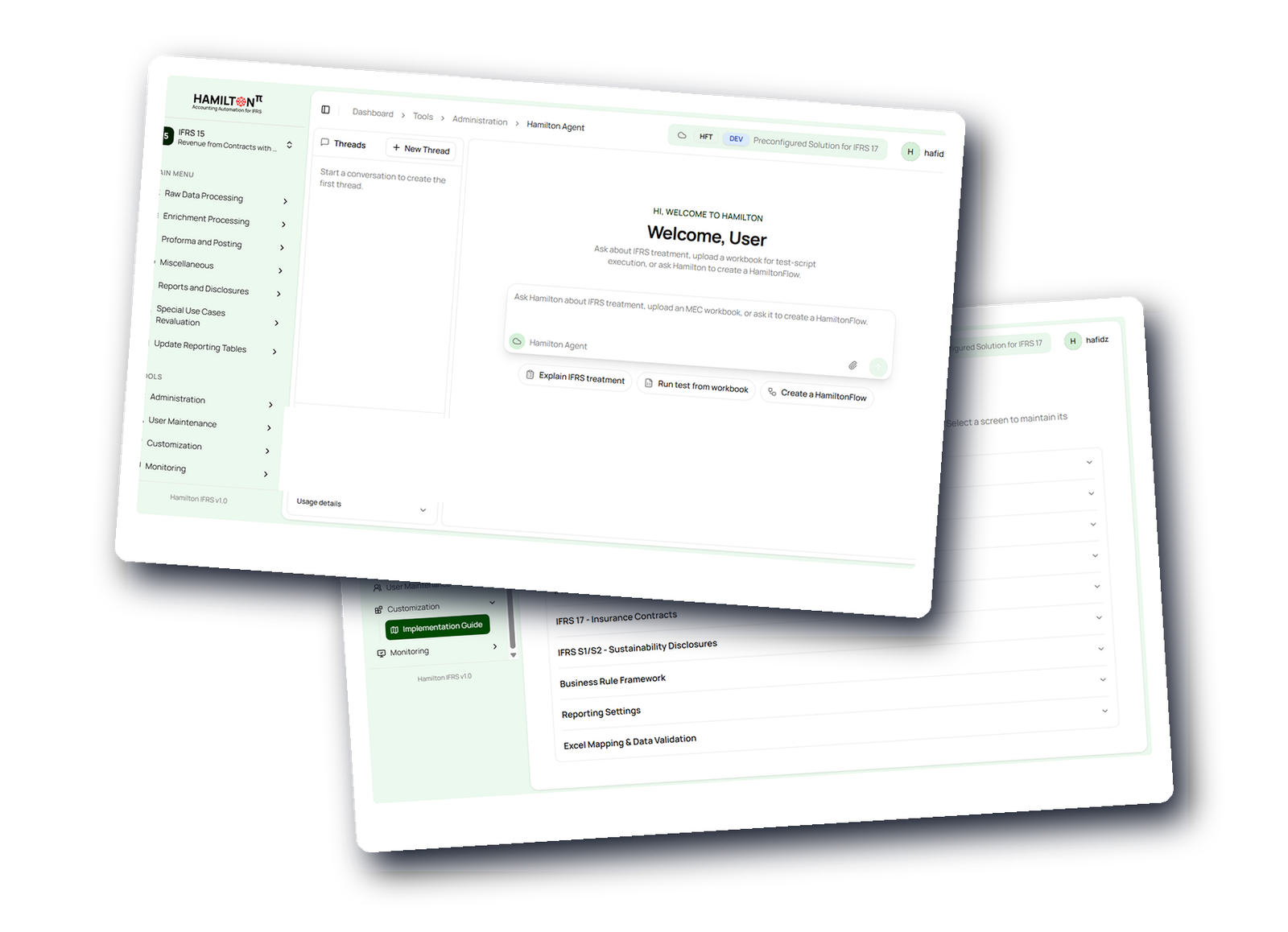
What Hamilton CEM handles
Works with your actuarial models
Hamilton connects to the models, data and tools your actuarial team already uses. You are not being asked to replace them.
Grouping
Define contract boundaries and groups that reflect profitability.
Fulfilment cash flows
Project premiums, claims, expenses and benefits over time.
Contractual service margin (CSM)
Calculate stored profit, release it as cover is provided, and recognise losses immediately where a group turns onerous.
Lifecycle
From new business to run-off, including changes in estimates and onerous testing.
Expected vs actual
Track experience, explain variances and act early.
Compare expected and actual outcomes through time. Identify variances, assess onerous contracts and reflect the impact in profit or loss.
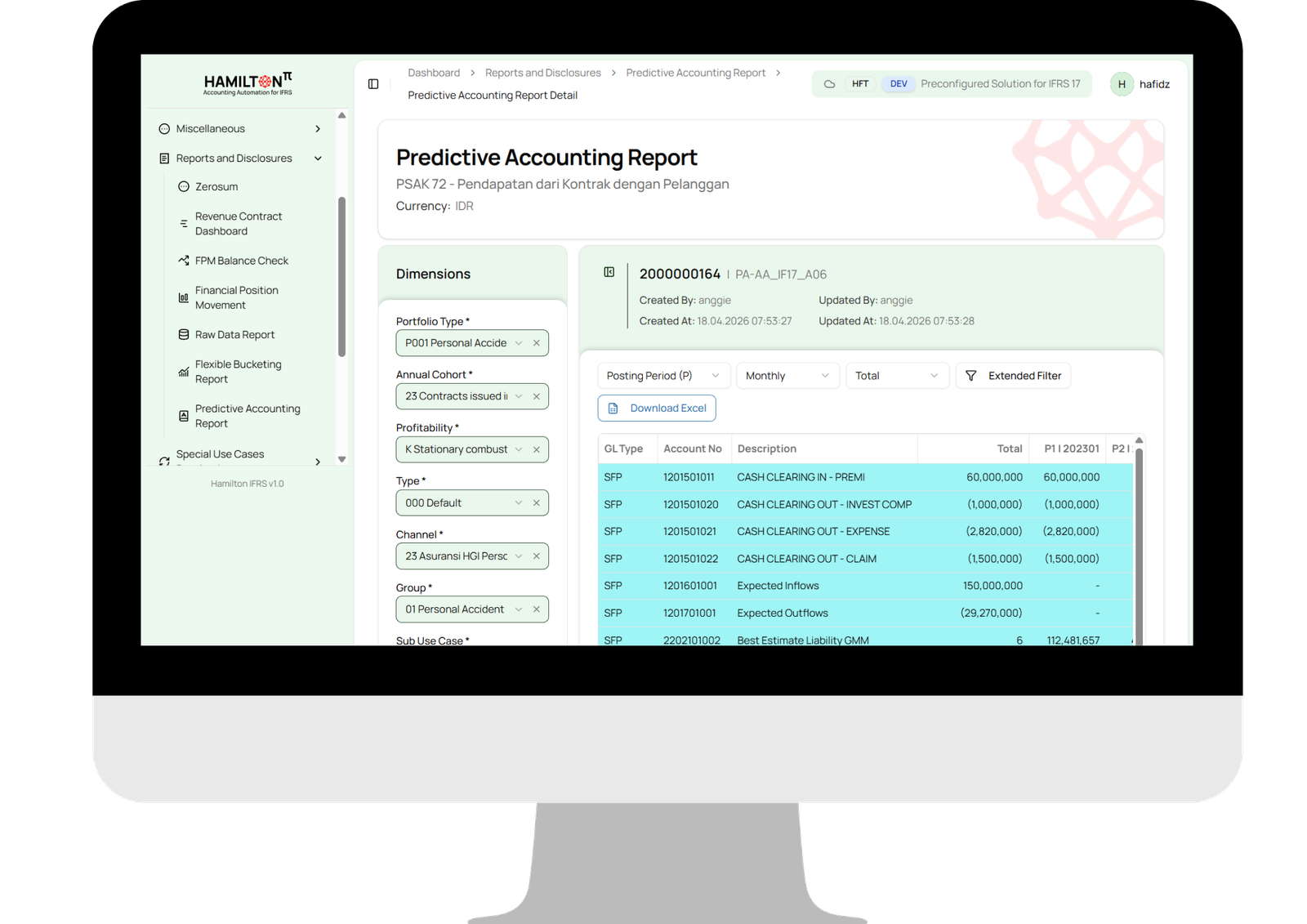
Built for every insurance business
Built for every insurance model.
Make contract economics visible.
Talk to us about bringing predictive accounting to your contract lifecycle.
Explore the standards